Back to: Health Information : Treatment or Therapy

Back Grounder
An Introduction to Reiki

On this page

An Introduction to Reiki

ReikiA therapy in which practitioners seek to transmit a universal energy to a person, either from a distance or by placing their hands on or near that person. The intent is to heal the spirit and thus the body. (pronounced "ray-kee") is an energy medicineTherapies that use energy fields with the intent to affect health. Some fields, such as magnetic fields and light, have been measured while others, such as biofields, have not. Examples of energy therapies include magnetic therapy and Reiki. practice that originated in Japan. In Reiki, the practitioner places his hands on or near the person receiving treatment, with the intent to transmit ki, believed to be a life-force energy. Practitioners also believe that they can treat themselves with Reiki and send ki across short or long distances. In the United States, Reiki is part of complementary and alternative medicine (CAM)A group of diverse medical and health care systems, practices, and products that are not presently considered to be part of conventional medicine. Complementary medicine is used together with conventional medicine, and alternative medicine is used in place of conventional medicine.. This Backgrounder provides a general overview of Reiki and suggests some resources you can use to learn more about this practice.

Top

Key Points

Top

Reiki as an Energy Medicine Therapy

The word Reiki is made up of two Japanese words: Rei, or universal spirit (sometimes thought of as a supreme being), and ki.

Thus, the word Reiki means "universal life energy."

In CAM, Reiki belongs to a domain (area of knowledge) called energy medicine. In this domain, therapies are based on the belief that disturbances in energy cause illness. Energy medicine practitioners seek to improve the flow and balance of energy in a beneficial way.

Top

About Energy Medicine

Energy medicine seeks to use, for potential health purposes, forces of two types:

Researchers have been interested in detecting and describing the physical properties of biofields. Some, using certain sophisticated tools, have claimed to detect or photograph differences in study participants before and after energy treatments. However, it is not clear what is being detected or photographed. Others have claimed to detect energy interactions between healers and people they treat. However, these findings have not been validated, and the exact nature of the energies is not clear.

Top

A Description of Reiki

Reiki is a therapy that the practitioner delivers through the hands, with intent to raise the amount of ki in and around the client, heal pathways for ki, and reduce negative energies. Reiki can be practiced in several ways: on its own, along with other CAM therapies, and along with conventional medical treatments.

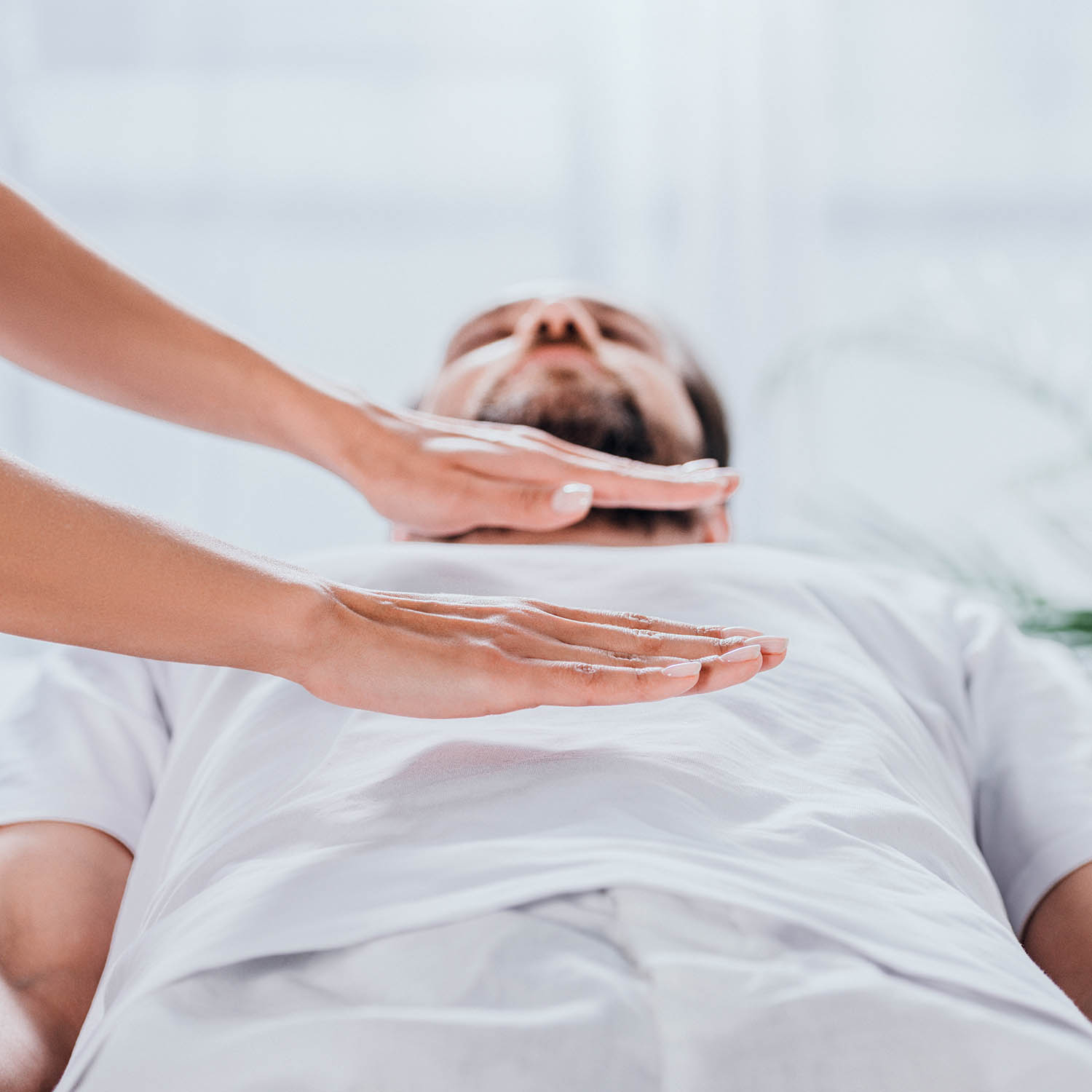
When a practitioner performs Reiki, usually the client sits or lies comfortably, fully clothed. The practitioner places her hands on or slightly above the client's body, using 12 to 15 different hand positions, with the intent to transmit ki. The hands are positioned with the palms down, fingers and thumbs extended. Each hand position is held until the practitioner feels that the flow of energy has slowed or stopped, typically about 2 to 5 minutes. Some Reiki practitioners believe they are helped by "spirit guides" for proper flow of the energy.

Practitioners perform Reiki most often in offices, hospitals, clinics, and private homes. The practitioner and client determine the number of sessions together. Typically, the practitioner delivers at least four sessions of 30 to 90 minutes each.

Depending on their level of training, people can perform Reiki on themselves as well as on people who are either close by or at some distance away (even at a long distance). In the latter case, Reiki is a type of "distant healing."

For more on this topic, see NCCAM's Backgrounder "Energy Medicine: An Overview."

Top

More About Ki

People who believe in the existence of ki hold that ki:

They also believe that if ki's flow is disrupted, the body's functioning becomes disrupted, and health problems can occur. The concept that sickness and disease arise from imbalances in a vital energy field is the foundation not only of Reiki but of some other CAM therapies, such as traditional Chinese medicineA whole medical system that originated in China. It is based on the concept that disease results from disruption in the flow of qi and imbalance in the forces of yin and yang. Practices such as herbs, meditation, massage, and acupuncture seek to aid healing by restoring the yin-yang balance and the flow of qi. (in which the energy is called qiIn traditional Chinese medicine, the vital energy or life force proposed to regulate a person's spiritual, emotional, mental, and physical health and to be influenced by the opposing forces of yin and yang. or chi) and homeopathyA whole medical system that originated in Europe. Homeopathy seeks to stimulate the body's ability to heal itself by giving very small doses of highly diluted substances that in larger doses would produce illness or symptoms (an approach called "like cures like"). (vital force).

Top

Use for Health Purposes

People have sought Reiki treatment for a wide variety of health-related purposes. Some examples include:

A recent national survey on Americans' use of CAM found that 1.1 percent of the 31,000 participants had used Reiki in the year before the survey.

Top

Effects of Reiki

Clients may report a deep feeling of relaxation after a Reiki session. Relaxation in and of itself may have beneficial health-related effects, such as reducing pain, nausea, and fatigue. A client might also experience warmth, tingling, sleepiness, refreshment, and/or the easing of one or more other symptoms after treatment.

Reiki appears to be generally safe, and serious side effects have not been reported. Some practitioners advise caution about using Reiki in people with psychiatric problems.

Sometimes a Reiki client experiences what practitioners call a "cleansing crisis." The person may have symptoms such as a feeling of weakness or tiredness, a headache, or a stomach ache. Reiki practitioners believe that these are effects of the body releasing toxins. They advise the client on how to deal with such symptoms if they occur, such as by getting more rest, drinking plenty of water, or eating a lighter diet.

Top

Some Other Points to Consider About Reiki as CAM

If you are considering or using Reiki as CAM:

Top

History of Reiki

There are different beliefs about the origin of Reiki--one is that it is based on Tibetan sutras (texts of Buddhism) written by monks. Sources agree that in the mid-19th century, Dr. Mikao Usui, a Japanese physician and monk, developed this healing approach and spiritual path, named it Reiki, trained others in it, and developed an organization.

One of Dr. Usui's students further developed these teachings and opened his own clinic in Tokyo, where, in 1936, an American named Hawayo Takata went for treatment. Later, she trained in Reiki, became a Master, and is credited with introducing Reiki to the West in the late 1930s.

Top

Training, Licensing, and Certification

A person does not need a special background or credentials to receive Reiki training. Many who seek the training are health care professionals. Students must learn the practice from an experienced Reiki teacher or Master, as it is not a therapy that can be self-taught.

There are a number of different schools of Reiki. Usually there are three or four levels (or degrees) of expertise, depending upon the school or type. Each level begins with an attunement, or initiation into that level. Receiving an attunement is believed to bring the ability to access Reiki energy and to open what is conceived as a central core of energy in the body.

Training for each level typically takes 1 or 2 days. The techniques taught can vary greatly between Reiki schools and teachers. In time, some students undertake the effort to become a Reiki Master, which enables one to teach Reiki and perform attunements. This process can take years. Some members of the Reiki professional community are interested in developing additional, voluntary standards for their profession.

The laws regulating the practice of Reiki vary from state to state, and sometimes by local areas as well. For example, in Florida, a Reiki practitioner must also be a certified massagePressing, rubbing, and moving muscles and other soft tissues of the body, primarily by using the hands and fingers. The aim is to increase the flow of blood and oxygen to the massaged area. therapist. Most other states do not consider Reiki to be massage and thus do not regulate it as a form of massage therapyPressing, rubbing, and moving muscles and other soft tissues of the body, primarily by using the hands and fingers. The aim is to increase the flow of blood and oxygen to the massaged area..

Top

Some Points of Controversy

As in other CAM therapies, there are areas of controversy in Reiki. For example:

Top

NCCAM-Funded Research

Some recent NCCAM-supported studies have been investigating:

Top

References

Sources are drawn primarily from recent reviews in English on Reiki in the PubMed database, selected evidence-based databases, and Federal sources.

Barnes PM, Powell-Griner E, McFann K, Nahin RL. Complementary and alternative medicine use among adults: United States, 2002. CDC Advance Report #343. 2004.

Chu DA. Tai chi, qi gong and Reiki. Physical Medicine and Rehabilitation Clinics of North America. 2004;15(4):774-781.

DiNucci EM. Energy healing: a complementary treatment for orthopaedic and other conditions. Orthopaedic Nursing. 2005;24(4):259-269.

Engebretson J, Wardell DW. Experience of a Reiki session. Alternative Therapies in Health and Medicine. 2002;8(2):48-53.

Healing touch: hands-on help for the heart? Touch therapies are reaching growing numbers of patients. Harvard Heart Letter. 2005;16(2):3.

International Association of Reiki Professionals Web site. Accessed at http://www.iarp.org on March 30, 2006.

LaTorre MA. The use of Reiki in psychotherapy. Perspectives in Psychiatric Care. 2005;41(4):184-187.

Miles P, True G. Reiki-review of a biofield therapy history, theory, practice, and research. Alternative Therapies in Health and Medicine. 2003;9(2):62-72.

National Center for Complementary and Alternative Medicine. Energy Medicine: An Overview.
National Center for Complementary and Alternative Medicine Web site. Accessed at http://nccam.nih.gov/health/backgrounds/energymed.htm on March 30, 2006.

National Center for Complementary and Alternative Medicine. Expanding Horizons of Health Care: Strategic Plan 2005-2009. Bethesda, MD: National Institutes of Health; 2005. NIH publication no. 04-5568.

Nield-Anderson L, Ameling A. Reiki: a complementary therapy for nursing practice. Journal of Psychosocial Nursing and Mental Health Services. 2001; 39(4):42-49.

Reiki. Natural Standard Database Web site. Accessed at http://www.naturalstandard.com on March 30, 2006.

Top

For More Information

NCCAM Clearinghouse

The NCCAM Clearinghouse provides information on CAM and NCCAM, including publications and searches of Federal databases of scientific and medical literature. The Clearinghouse does not provide medical advice, treatment recommendations, or referrals to practitioners.

Toll-free in the U.S.: 1-888-644-6226
TTY (for deaf and hard-of-hearing callers): 1-866-464-3615
Web site: nccam.nih.gov
E-mail: info@nccam.nih.gov

PubMed®

A service of the National Library of Medicine (NLM), PubMed contains publication information and (in most cases) brief summaries of articles from scientific and medical journals. CAM on PubMed, developed jointly by NCCAM and NLM, is a subset of the PubMed system and focuses on the topic of CAM.

Web site: www.ncbi.nlm.nih.gov/entrez
CAM on PubMed: nccam.nih.gov/camonpubmed/

CRISP (Computer Retrieval of Information on Scientific Projects)

CRISP is a database of information on federally funded scientific and medical research projects being conducted at research institutions.

Web site: www.crisp.cit.nih.gov

ClinicalTrials.gov

ClinicalTrials.gov is a database of information on federally and privately supported clinical trials (research studies in people) for a wide range of diseases and conditions. It is sponsored by the National Institutes of Health and the U.S. Food and Drug Administration.

Web site: www.clinicaltrials.gov

Top

Acknowledgments

NCCAM thanks the following people for their technical expertise and review of this publication: Joan Fox, Ph.D., and Didier Allexandre, Ph.D., The Cleveland Clinic; Karen Prestwood, M.D., University of Connecticut Health Center; Gala True, Ph.D., Albert Einstein Healthcare Network; and Morgan Jackson, M.D., and Shan Wong, Ph.D., NCCAM.

Top

NCCAM has provided this material for your information. It is not intended to substitute for the medical expertise and advice of your primary health care provider. We encourage you to discuss any decisions about treatment or care with your health care provider. The mention of any product, service, or therapy is not an endorsement by NCCAM.

This publication is not copyrighted and is in the public domain. Duplication is encouraged.

National Institutes of Health

U.S. Department of Health and Human Services

NCCAM Publication No. D315
Created April 2006
Updated June 2007

Top