 An official website of the United States government
Hawthorn
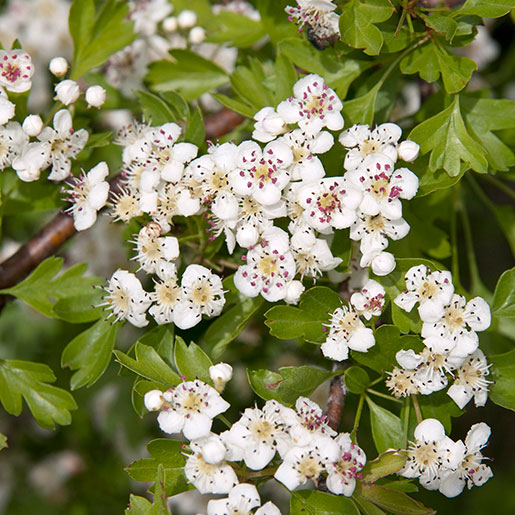
Common Names: hawthorn, English hawthorn, oneseed hawthorn, harthorne, haw, hawthorne
Latin Names: Crataegus monogyna, Crataegus laevigata (synonym Crataegus oxyacantha)
Background
- Hawthorn is a flowering shrub or tree of the rose family. It grows in temperate regions throughout the world.
- Historically, hawthorn has been used for heart disease as well as for digestive and kidney problems. It is now promoted for these uses as well as for anxiety, high or low blood pressure, and other conditions.
How Much Do We Know?
- Hawthorn has been studied for heart failure in people. Heart failure is a condition in which the heart can’t pump as much blood as it should.
- Not much is known about hawthorn for any other health conditions as there is little or no evidence.
What Have We Learned?
- There is conflicting evidence about the effects of hawthorn in people with heart failure. Although some older, short-term studies suggested that hawthorn may have benefits in patients with heart failure, other, more recent, studies did not confirm these benefits. In these studies, unlike some of the older ones, patients were given hawthorn in addition to the recommended conventional treatments for heart failure. One of the studies suggested possible harm in people taking hawthorn as it appears to increase the early risk of heart failure progression.
What Do We Know About Safety?
- In most studies of hawthorn for heart failure, no serious safety problems have been reported. However, in one study, patients taking hawthorn were more likely than those taking a placebo (an inactive substance) to have their heart failure get worse soon after the study started. The reason for this is not clear, but one possibility is that hawthorn might have interacted with drugs the patients were taking.
- Side effects of hawthorn can include dizziness, nausea, and digestive symptoms.
- Hawthorn may interact in harmful ways with drugs, including some heart medications. If you’re taking medication and you’re considering using hawthorn, consult your health care provider.
- Little is known about whether it’s safe to use hawthorn during pregnancy or while breastfeeding.
Keep in Mind
- Take charge of your health—talk with your health care providers about any complementary health approaches you use. Together, you can make shared, well-informed decisions.
NCCIH Clearinghouse
The NCCIH Clearinghouse provides information on NCCIH and complementary and integrative health approaches, including publications and searches of Federal databases of scientific and medical literature. The Clearinghouse does not provide medical advice, treatment recommendations, or referrals to practitioners.
Toll-free in the U.S.: 1-888-644-6226
Telecommunications relay service (TRS): 7-1-1
Website: https://www.nccih.nih.gov
Email: info@nccih.nih.gov (link sends email)
PubMed®
A service of the National Library of Medicine, PubMed® contains publication information and (in most cases) brief summaries of articles from scientific and medical journals. For guidance from NCCIH on using PubMed, see How To Find Information About Complementary Health Approaches on PubMed.
Website: https://pubmed.ncbi.nlm.nih.gov/
Office of Dietary Supplements (ODS), National Institutes of Health (NIH)
ODS seeks to strengthen knowledge and understanding of dietary supplements by evaluating scientific information, supporting research, sharing research results, and educating the public. Its resources include publications (such as Dietary Supplements: What You Need To Know) and fact sheets on a variety of specific supplement ingredients and products (such as vitamin D and multivitamin/mineral supplements).
Website: https://ods.od.nih.gov
Email: ods@nih.gov (link sends email)
Key References
- Hawthorn. Natural Medicines website. Accessed at naturalmedicines.therapeuticresearch.com on January 22, 2020. [Database subscription].
- Holubarsch CJF, Colucci WS, Meinertz T, et al. The efficacy and safety of Crataegus extract WS 1442 in patients with heart failure: the SPICE trial. European Journal of Heart Failure. 2008;10(12):1255-1263.
- Holubarsch CJF, Colucci WS, Eha J. Benefit-risk assessment of Crataegus extract US 1442: an evidence-based review. American Journal of Cardiovascular Drugs. 2018;18(1):25-36.
- Koch E, Busse WR, Juretzek W, et al. Hawthorn. In: Coates PM, Betz JM, Blackman MR, et al., eds. Encyclopedia of Dietary Supplements. 2nd ed. New York, NY: Informa Healthcare; 2010:411-422.
- Pittler MH, Guo R, Ernst E. Hawthorn extract for treating chronic heart failure. Cochrane Database of Systematic Reviews. 2008;(1):CD005312 [edited 2009]. Accessed at https://www.cochranelibrary.com on January 27, 2020.
- Zick SM, Gillespie B, Aaronson KD. The effect of Crataegus oxycantha special extract WS 1442 on clinical progression in patients with mild to moderate symptoms of heart failure. European Journal of Heart Failure. 2008;10(6):587-593.
- Zick SM, Vautaw BM, Gillespie B, et al. Hawthorn extract randomized blinded chronic heart failure (HERB CHF) trial. European Journal of Heart Failure. 2009;11(10):990-999.
- Zorniak M, Szydlo B, Krzeminski TF. Crataegus special extract WS 1442: up-to-date review of experimental and clinical experiences. Journal of Physiology and Pharmacology. 2017;68(4):521-526.
This publication is not copyrighted and is in the public domain. Duplication is encouraged.
NCCIH has provided this material for your information. It is not intended to substitute for the medical expertise and advice of your health care provider(s). We encourage you to discuss any decisions about treatment or care with your health care provider. The mention of any product, service, or therapy is not an endorsement by NCCIH.