 An official website of the United States government
Black Cohosh
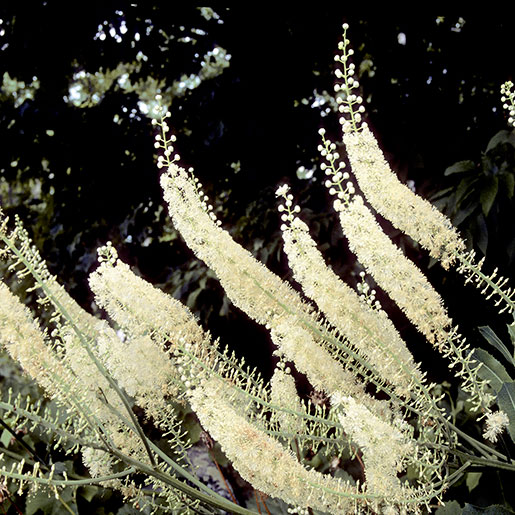
Common Names: black cohosh, black snakeroot, macrotys, bugbane, bugwort, rattleroot, rattleweed
Latin Names: Actaea racemosa, Cimicifuga racemosa
Background
- Black cohosh, a member of the buttercup family, grows in North America. Native Americans traditionally used black cohosh for a variety of ailments and introduced it to European colonists.
- Currently, black cohosh is promoted as a dietary supplement for hot flashes and other menopausal symptoms. It’s also been promoted for other conditions, including menstrual cramps and premenstrual syndrome, and to induce labor.
- The part of the black cohosh plant used in herbal preparations is the root or rhizome (underground stem).
How Much Do We Know?
- Black cohosh has been studied for menopause symptoms in people. Most of the older studies were not of the highest quality. More recent studies have been of higher quality, but they have differed in the formulation, plant species, or dose used, so it’s difficult to know the herb’s effects with any certainty. Black cohosh has not been studied as much for conditions other than menopause.
What Have We Learned?
- Research suggests that certain black cohosh extracts and some combination products containing black cohosh may reduce some menopause symptoms. Most of the research has been on a single extract called Remifemin. Research on other black cohosh products has had inconsistent results. Guidelines released in 2015 indicate that there is a lack of consistent evidence for any benefit from black cohosh for menopause symptoms. But a 2017 review of recent research suggests that black cohosh extracts approved for treatment in Europe seem to decrease menopause symptoms.
- The research is inconsistent on whether black cohosh helps to reduce hot flashes that are related to breast cancer treatment. People with breast cancer should avoid using black cohosh before talking with their health care provider.
- There aren’t enough reliable data to show whether black cohosh is effective for other uses.
What Do We Know About Safety?
- In clinical trials, people have taken black cohosh for as long as 12 months with no serious harmful effects.
- Black cohosh can cause some mild side effects, such as stomach upset, cramping, headache, rash, a feeling of heaviness, vaginal spotting or bleeding, and weight gain.
- Some commercial black cohosh products have been found to contain the wrong herb or to contain mixtures of black cohosh and other herbs that are not listed on the label.
- Cases of liver damage—some very serious—have been reported in people taking commercial black cohosh products. These problems are rare, and it is uncertain whether black cohosh was responsible for them. Nevertheless, people with liver disorders should consult a health care provider before taking black cohosh products, and anyone who develops symptoms of liver trouble, such as abdominal swelling, dark urine, or jaundice, while taking black cohosh should stop using it and consult a health care provider.
- The risk of interactions between black cohosh and medicines appears to be small. Preliminary animal research supported by NCCIH and other laboratory research suggested that black cohosh might affect statin medicines, which are used to reduce blood cholesterol levels.
- It’s not clear if black cohosh is safe for women who have had hormone-sensitive conditions such as breast cancer.
- Little is known about whether it’s safe to use black cohosh during pregnancy or while breastfeeding.
- Black cohosh should not be confused with blue cohosh (Caulophyllum thalictroides), which has different effects and may not be safe. Black cohosh has sometimes been used with blue cohosh to stimulate labor, but this use was linked to severe adverse effects in at least one newborn.
Keep in Mind
- Take charge of your health—talk with your health care providers about any complementary health approaches you use. Together, you can make shared, well-informed decisions.
NCCIH Clearinghouse
The NCCIH Clearinghouse provides information on NCCIH and complementary and integrative health approaches, including publications and searches of Federal databases of scientific and medical literature. The Clearinghouse does not provide medical advice, treatment recommendations, or referrals to practitioners.
Toll-free in the U.S.: 1-888-644-6226
Telecommunications relay service (TRS): 7-1-1
Website: https://www.nccih.nih.gov
Email: info@nccih.nih.gov (link sends email)
PubMed®
A service of the National Library of Medicine, PubMed® contains publication information and (in most cases) brief summaries of articles from scientific and medical journals. For guidance from NCCIH on using PubMed, see How To Find Information About Complementary Health Approaches on PubMed.
Website: https://pubmed.ncbi.nlm.nih.gov/
Office of Dietary Supplements (ODS), National Institutes of Health (NIH)
ODS seeks to strengthen knowledge and understanding of dietary supplements by evaluating scientific information, supporting research, sharing research results, and educating the public. Its resources include publications (such as Dietary Supplements: What You Need To Know) and fact sheets on a variety of specific supplement ingredients and products (such as vitamin D and multivitamin/mineral supplements).
Website: https://ods.od.nih.gov
Email: ods@nih.gov (link sends email)
Key References
- Asher GN, Corbett AH, Hawke RL. Common herbal dietary supplement-drug interactions. American Family Physician. 2017;96(2):101-107.
- Black cohosh. Natural Medicines website. Accessed at naturalmedicines.therapeuticresearch.com on December 5, 2019. [Database subscription].
- Fabricant DS, Krause EC, Farnsworth NR. Black cohosh. In: Coates PM, Betz JM, Blackman MR, et al., eds. Encyclopedia of Dietary Supplements. 2nd ed. New York, NY: Informa Healthcare; 2010:60-74.
- Hill DA, Crider M, Hill SR. Hormone therapy and other treatments for symptoms of menopause. American Family Physician. 2016;94(11):884-889.
- Masada S. Authentication of the botanical origin of Western herbal products using Cimicifuga and Vitex products as examples. Journal of Natural Medicines. 2016;70(3):361-375.
- Moore TR, Franks RB, Fox C. Review of efficacy of complementary and alternative medicine treatments for menopausal symptoms. Journal of Midwifery & Women’s Health. 2017;62(3):286-297.
- Sarri G, Pedder H, Dias S, et al. Vasomotor symptoms resulting from natural menopause: a systematic review and network meta-analysis of treatment effects from the National Institute for Health and Care Excellence guideline on menopause. BJOG. 2017;124(10):1514-1523.
- Stuenkel CA, Davis SR, Gompel A, et al. Treatment of symptoms of the menopause: an Endocrine Society clinical practice guideline. The Journal of Clinical Endocrinology & Metabolism. 2015;100(11):3975-4011.
This publication is not copyrighted and is in the public domain. Duplication is encouraged.
NCCIH has provided this material for your information. It is not intended to substitute for the medical expertise and advice of your health care provider(s). We encourage you to discuss any decisions about treatment or care with your health care provider. The mention of any product, service, or therapy is not an endorsement by NCCIH.